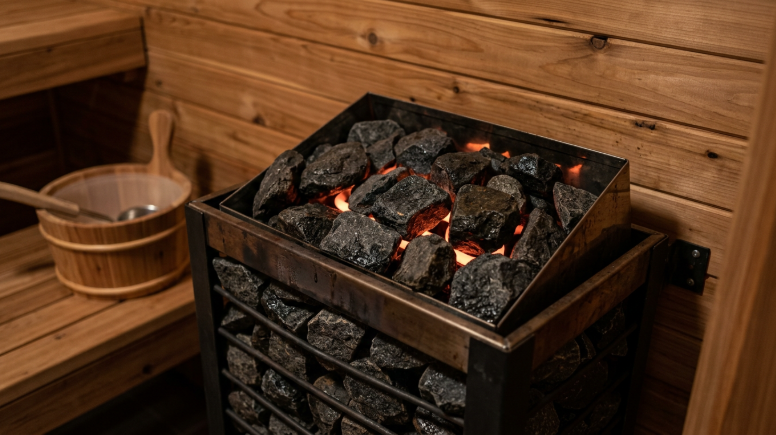
A trustworthy electric sauna heater warranty covers the heating elements for 2 to 5 years and the control panel or wiring for 1 to 2 years, clearly states what voids coverage, and is printed in full on the product page rather than buried in a PDF. Rocks are never covered, since they are a wear item, not a defect. A warranty shorter than a year, vague language like “limited warranty” with no specifics, or one only available on request is worth treating as a signal to look elsewhere or at least ask direct questions before ordering.
What Should Actually Be Covered?
The heating elements are the part most worth a real warranty, since they are the component most likely to fail and the most expensive to replace outside of coverage. Established brands typically cover elements for 2 to 5 years, sometimes longer on premium models. The control panel, whether analog or digital, and the internal wiring usually carry a shorter 1 to 2 year warranty, reflecting that these are lower-failure-rate components but not zero-risk ones. A warranty that lumps everything into one vague “1 year, parts only” statement without breaking out elements separately is worth a direct question to the seller before buying.
See also: Mutf_In: Max_Life_Grow_2gohh
What Is Never Covered, No Matter the Brand?
Rocks are a consumable, not a covered part, on essentially every manufacturer’s warranty, since they are expected to crack and wear down from routine heat and water contact regardless of build quality. Cosmetic wear on the outer casing, normal color change on heating elements over years of use, and damage from water intrusion beyond what the unit is rated for are also typically excluded. None of this is unusual or a red flag on its own, it is simply the standard shape of a sauna heater warranty, and budgeting for rock replacement every 1 to 2 years separately from any warranty coverage avoids confusion later.
Can Installation Choices Void the Warranty?
Yes, and this is the clause buyers skip reading most often. Manufacturers generally require the heater to be installed within the clearances specified in the install manual, on a circuit sized to the manual’s amperage rating, and in some cases specifically state that installation by a licensed electrician is required for the warranty to remain valid on units above a certain kilowatt rating. Installing a heater on an undersized circuit, skipping a required guard rail, or mounting it closer to combustible wood than specified can all void coverage even if the heater itself was not defective. Keeping a copy of the install manual and, where applicable, the electrician’s invoice on file is the simplest way to protect a future claim.
How Long Should a Buyer Expect to Wait for a Warranty Claim?
Response times vary meaningfully between brands, and this is not usually stated on the product page, which is exactly why it is worth asking before buying rather than after something breaks. A brand with a domestic parts warehouse and responsive support can often resolve an element replacement within 1 to 2 weeks, while a brand relying on overseas parts shipping can stretch a claim to 6 to 8 weeks or longer. Reading recent buyer reviews specifically for mentions of warranty claim experience, not just initial product satisfaction, is one of the more reliable ways to catch this before it becomes a problem.
What Should a Buyer Compare Before Ordering?
Beyond kilowatt rating and price, worth comparing side by side across models are stated element warranty length, whether the control panel is covered separately, and whether the warranty explicitly names licensed-electrician installation as a requirement. Current heater listings at retailers like sweatdecks.com typically print warranty terms directly on the product page next to the kilowatt and rock capacity specs, which makes a side-by-side comparison realistic before committing to one model over another. A listing that omits warranty terms entirely is worth a direct question before ordering, not an assumption that coverage is standard.
Does Warranty Length Say Anything About Long-Term Reliability?
A longer warranty is not a guarantee of better build quality on its own, but it is a reasonable proxy, since a manufacturer confident in its element quality and rock basket design has less financial incentive to shorten coverage. This mirrors the broader pattern in sauna research generally: a review in The American Journal of Medicine on benefits and risks of sauna bathing, and a 2018 review in Mayo Clinic Proceedings on cardiovascular associations, both point to consistent, long-term use as the variable that matters most, which only happens with a heater that keeps working reliably over years rather than one that fails and sits unused waiting on a slow warranty claim.
What Common Warranty Traps Should Buyers Watch For?
A “lifetime warranty” claim on a budget heater is worth reading carefully, since it often applies only to the outer cabinet or casing rather than the heating elements, which is the part actually likely to fail. Some listings also advertise warranty length prominently in marketing copy but bury exclusions, like self-installation voiding coverage, in a separate downloadable document that is easy to miss before purchase. Asking a seller directly to confirm, in writing, what the warranty covers and what specifically voids it is a reasonable and normal question, not an awkward one, and a seller who hedges on a direct question is worth treating as a signal.
Prorated warranties are another detail worth checking. Some brands cover an element fully for the first year or two, then shift to a prorated replacement cost for the remaining warranty period, meaning a failure in year four might only get partial credit toward a replacement part rather than a free one. This is standard practice at some brands and not a red flag on its own, but it changes the real value of a “5 year warranty” claim enough that it is worth confirming before treating two competing warranties as equivalent.
Frequently Asked Questions
What is a normal warranty length for an electric sauna heater? Established brands typically warranty elements for 2 to 5 years and the control panel or wiring for 1 to 2 years. Under 1 year is a common sign of a lower-quality import.
Does a sauna heater warranty cover the rocks? No. Rocks are a consumable that wears down from normal use and should be budgeted as a recurring cost, not treated as a defect.
Does improper installation void a sauna heater warranty? Usually yes. Clearances, circuit sizing, and sometimes licensed-electrician installation are common requirements, and skipping them is a common reason claims get denied.
What should a buyer ask before purchasing based on warranty terms? What’s covered, what voids coverage, and whether the warranty is prorated after a certain number of years. A seller who cannot answer clearly is a caution sign.
References
- Clinical Effects of Regular Dry Sauna Bathing: A Systematic Review, Evidence-Based Complementary and Alternative Medicine, 2018
- Does the Combination of Finnish Sauna Bathing and Other Lifestyle Factors Confer Additional Health Benefits? A Review of the Evidence, Mayo Clinic Proceedings, 2023
- Effects of heat and cold on health, with special reference to Finnish sauna bathing, American Journal of Physiology, 2018
- UL Product Safety Standards, UL Solutions
By Marcus Yates